
Mifos Implementation Timeline: Complete Guide to Successful Core Banking Deployment
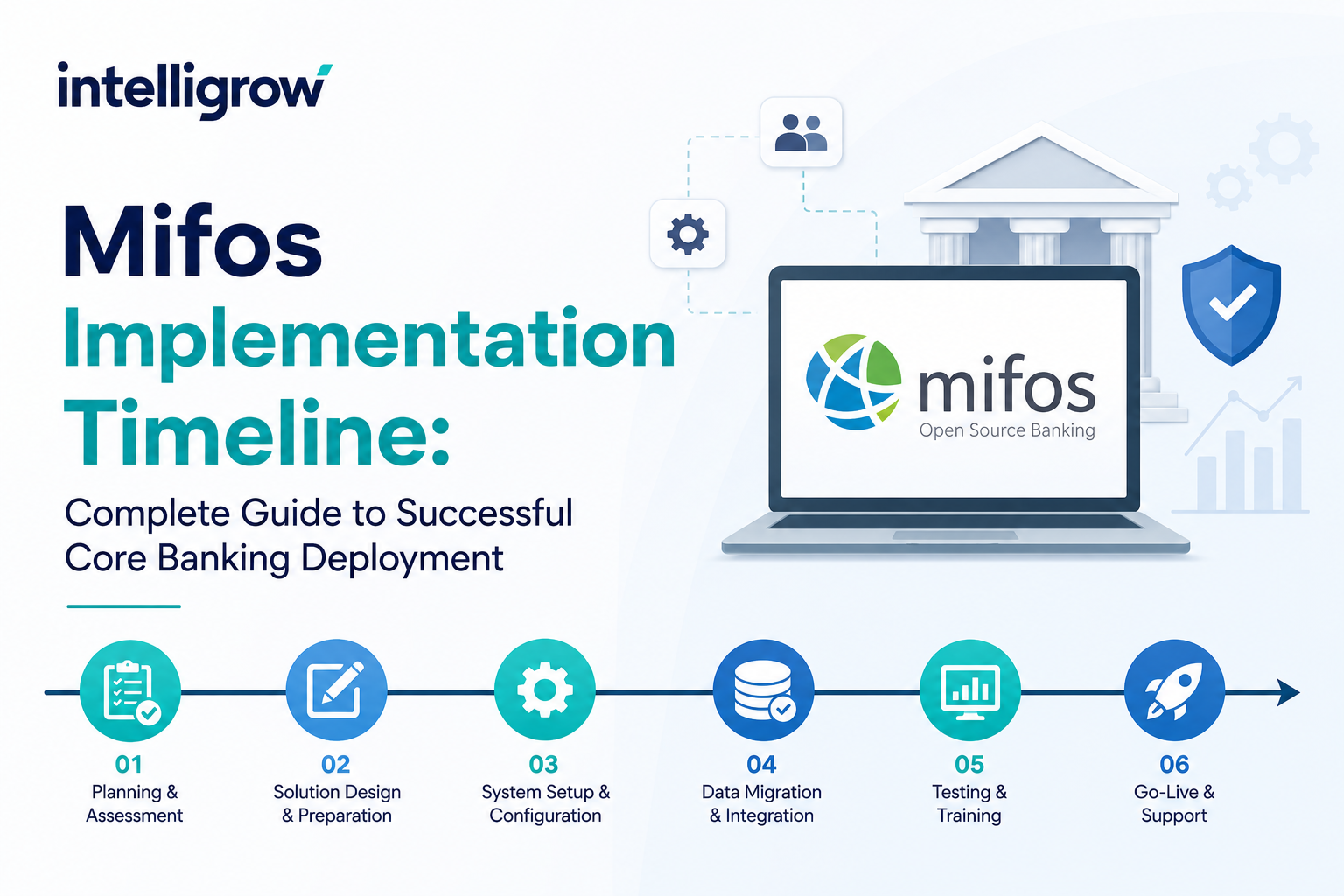
Mifos Implementation Timeline: Complete Guide to Successful Core Banking Deployment
The successful implementation of a core banking platform requires careful planning, structured execution, and collaboration between business stakeholders and technical teams. Whether you are a Microfinance Institution (MFI), Non-Banking Financial Company (NBFC), SACCO, Cooperative Bank, Credit Union, or FinTech, understanding the Mifos implementation timeline is essential for ensuring a smooth transition to a modern digital banking platform.
Unlike conventional software installations, implementing Mifos involves multiple implementation phases, including business analysis, solution design, product configuration, customization, third-party integrations, data migration, testing, user training, and post-go-live support. Each phase contributes to the overall project duration and helps organizations minimize risks while maximizing operational efficiency.
At Intelligrow, we help financial institutions successfully implement Mifos through a structured project approach that accelerates deployment while ensuring scalability, security, and compliance with business and regulatory requirements.
Learn more about our Mifos Implementation Services:
https://intelligrow.co/mifos-implementation/
What is a Mifos Implementation Timeline?
A Mifos implementation timeline is a structured roadmap that outlines every stage involved in deploying the Mifos core banking platform. It provides financial institutions with a clear understanding of project milestones, estimated implementation duration, responsibilities, and deliverables.
A well-planned timeline ensures that all implementation activities are completed systematically while reducing operational disruptions and project risks.
Although the duration of a Mifos implementation varies depending on the size and complexity of the organization, most projects follow a series of well-defined phases that lead from initial planning to production deployment.
If your organization is planning a complete digital transformation, you may also be interested in Intelligrow's Apache Fineract Services:
https://intelligrow.co/apache-fineract-services/
Why is Planning the Implementation Timeline Important?
A clearly defined implementation timeline helps financial institutions maintain project visibility and ensure that each stage receives adequate planning and execution.
Benefits include:
- Better project governance
- Improved stakeholder collaboration
- Efficient resource allocation
- Reduced implementation risks
- Predictable deployment schedules
- Faster issue resolution
- Improved regulatory compliance
- Higher user adoption
- Better project cost management
Organizations that establish realistic timelines are better positioned to complete implementations successfully without compromising quality.
Typical Mifos Implementation Phases
Although every implementation is unique, most Mifos projects follow these standard phases.
Phase 1: Business Analysis and Requirement Gathering
The implementation begins by understanding the institution's business processes, operational workflows, lending products, savings products, compliance requirements, and reporting needs.
Key activities include:
- Stakeholder workshops
- Business process analysis
- Requirement gathering
- Product mapping
- Gap analysis
- Regulatory review
- Project scope definition
This phase establishes the foundation for the entire implementation.
Learn more about our Mifos Consulting Services:
https://intelligrow.co/mifos-consulting/
Phase 2: Solution Design and Project Planning
After gathering business requirements, the implementation team prepares a detailed solution architecture and implementation roadmap.
Activities include:
- Infrastructure planning
- Security design
- Deployment strategy
- API planning
- User role definition
- Project scheduling
- Risk assessment
Proper planning minimizes project delays and ensures all stakeholders understand the implementation approach.
Phase 3: Configuration and Customization
During this phase, Mifos is configured to reflect the institution's business processes.
Configuration may include:
- Loan products
- Savings products
- Interest calculations
- Accounting rules
- Branch setup
- User permissions
- Approval workflows
- Regulatory reporting
Organizations requiring specialized workflows may also implement custom functionality.
Explore our Mifos Customization Services:
https://intelligrow.co/mifos-customization/
Phase 4: Third-Party Integrations
Modern financial institutions depend on multiple external systems.
Common integrations include:
- Payment gateways
- Credit bureaus
- National identity systems
- CRM platforms
- Accounting software
- Mobile banking applications
- SMS gateways
- Email services
- Digital wallets
Each integration is designed, developed, tested, and validated before production deployment.
Learn more about Mifos Integration Services:
https://intelligrow.co/mifos-integration/
Phase 5: Data Migration
Migrating existing customer and financial data is one of the most critical stages of implementation.
Typical migration activities include:
- Data assessment
- Data cleansing
- Data mapping
- Validation
- Trial migration
- Production migration
Careful migration planning minimizes operational disruptions and ensures data integrity.
Explore our Mifos Migration Services:
https://intelligrow.co/mifos-migration/
Phase 6: Testing and Quality Assurance
Before production deployment, comprehensive testing is performed to verify that the platform functions correctly.
Testing typically includes:
- Functional testing
- Integration testing
- Performance testing
- Security testing
- User Acceptance Testing (UAT)
This phase helps identify and resolve issues before the system goes live.
Phase 7: User Training
Successful implementations depend on effective user adoption.
Training is provided for:
- Loan officers
- Branch managers
- Finance teams
- Operations staff
- IT administrators
- System administrators
Well-trained users improve productivity and reduce post-launch support requirements.
Phase 8: Go-Live and Post-Implementation Support
After successful testing, the production environment is launched.
Post-go-live activities include:
- Production monitoring
- Hypercare support
- Issue resolution
- Performance optimization
- Software updates
- Continuous improvements
Long-term support ensures the platform continues to meet evolving business needs.
Learn more about our Mifos Support & Maintenance Services:
https://intelligrow.co/mifos-support-maintenance/
Factors That Influence the Implementation Duration
Every implementation timeline varies depending on several factors, including:
- Organization size
- Number of branches
- Number of users
- Product complexity
- Level of customization
- Third-party integrations
- Data migration complexity
- Regulatory requirements
- Infrastructure readiness
- Availability of business stakeholders
Organizations with well-defined requirements typically experience faster and more efficient implementations.
Best Practices for Staying on Schedule
Financial institutions can improve implementation success by:
- Defining business requirements early
- Assigning dedicated project stakeholders
- Preparing clean and validated data
- Limiting unnecessary customizations
- Planning integrations in advance
- Conducting thorough testing
- Providing comprehensive user training
- Partnering with an experienced implementation team
These best practices help reduce delays and ensure a successful deployment.
Frequently Asked Questions
How long does a Mifos implementation take?
The timeline depends on project complexity, customization, integrations, and migration requirements. Smaller implementations may be completed more quickly, while larger enterprise projects require additional planning and execution.
What phase takes the longest?
Configuration, customization, integrations, and data migration are typically the most time-intensive phases.
Can Mifos be implemented in stages?
Yes. Many financial institutions begin with core lending functionality and gradually expand to savings, accounting, mobile banking, and additional integrations.
What factors can delay implementation?
Common causes include changing business requirements, incomplete data migration, delayed stakeholder approvals, integration challenges, and insufficient testing.
Why Choose Intelligrow for Mifos Implementation?
Implementing Mifos successfully requires technical expertise, banking domain knowledge, and a structured project methodology. Intelligrow helps financial institutions accelerate implementation while minimizing operational risks.
Our services include:
- Mifos Implementation
- Business Analysis
- Product Configuration
- Mifos Customization
- API Development & Integration
- Data Migration
- Cloud Deployment
- Performance Optimization
- User Training
- Ongoing Support & Maintenance
Our experienced consultants work closely with banks, NBFCs, MFIs, SACCOs, and fintech organizations to deliver scalable and future-ready core banking solutions.
Explore our successful projects:
https://intelligrow.co/case-studies/
See where we've delivered projects:
https://intelligrow.co/client-locations/
Learn more about Intelligrow:
https://intelligrow.co/about-us/
Conclusion
A well-planned Mifos implementation timeline is the foundation of a successful core banking transformation. By following a structured approach—from business analysis and solution design to configuration, integrations, data migration, testing, training, and post-go-live support—financial institutions can reduce implementation risks and accelerate digital transformation.
Whether you are an NBFC, MFI, SACCO, cooperative bank, credit union, or fintech company, partnering with an experienced implementation provider ensures your Mifos deployment aligns with your operational goals and long-term growth strategy.
At Intelligrow, we provide end-to-end Mifos implementation services that help organizations deploy secure, scalable, and future-ready banking solutions.
If you're planning a Mifos implementation project, our experts are ready to help.
Contact us today:
https://intelligrow.co/contact/
Suggested Internal Links Used in This Article
- Mifos Implementation: https://intelligrow.co/mifos-implementation/
- Mifos Consulting: https://intelligrow.co/mifos-consulting/
- Mifos Customization: https://intelligrow.co/mifos-customization/
- Mifos Integration: https://intelligrow.co/mifos-integration/
- Mifos Migration: https://intelligrow.co/mifos-migration/
- Mifos Support & Maintenance: https://intelligrow.co/mifos-support-maintenance/
- Apache Fineract Services: https://intelligrow.co/apache-fineract-services/
FAQ
Frequently asked questions
The duration of a Mifos implementation depends on factors such as business complexity, customization requirements, third-party integrations, data migration, and user training. While smaller implementations can be completed more quickly, larger projects involving multiple branches and complex workflows generally require additional planning and execution. A structured implementation roadmap helps ensure the project is delivered efficiently.
About Intelligrow
Experts in Digital Lending & Core Banking
Intelligrow helps banks, NBFCs, microfinance institutions, fintechs and digital lenders modernize their technology using Mifos, Apache Fineract, digital lending platforms and core banking solutions.
Our team provides implementation, customization, migration, API integrations, cloud deployment and long-term support for financial institutions across multiple countries.
Related topics
Mifos
Mifos Data Migration Guide: Complete Step-by-Step Guide for a Successful Banking Migration
July 6, 2026
Mifos
Common Mifos Implementation Challenges: Problems, Solutions & Best Practices
July 6, 2026
Mifos
Mifos Implementation Checklist: Complete Project Planning Guide for Financial Institutions
July 6, 2026