
Apache Fineract Microservices: Complete Guide to Building Scalable Core Banking Applications
Apache Fineract Microservices: Complete Guide to Building Scalable Core Banking Applications
The banking industry has shifted from monolithic applications to modern cloud-native architectures capable of supporting millions of customers, real-time transactions, digital channels, and continuous innovation. Traditional core banking systems often become difficult to scale because every component depends on a single application. As institutions grow, maintaining and upgrading these systems becomes increasingly complex.
Microservices architecture addresses these challenges by dividing a large application into smaller, independent services. Each service performs a specific business function and communicates with other services using APIs. This approach improves scalability, reliability, flexibility, and deployment speed.
Apache Fineract has evolved to support modern architectural principles that make it suitable for cloud-native banking environments. Combined with REST APIs, container technologies, and orchestration platforms, Apache Fineract enables organizations to build modular banking solutions that can evolve with changing business needs.
Banks, NBFCs, Microfinance Institutions (MFIs), SACCOs, Credit Unions, Cooperatives, and FinTech companies increasingly adopt microservices to accelerate digital transformation while maintaining operational resilience.
This guide explains Apache Fineract Microservices architecture, benefits, implementation approaches, deployment strategies, security considerations, and best practices.
Organizations should first understand the overall Apache Fineract architecture before adopting microservices.
Internal Link:
https://intelligrow.co/blog/apache-fineract-architecture/
What are Microservices?
Microservices are an architectural style in which an application is divided into multiple independent services.
Each microservice:
- Performs One Business Function
- Runs Independently
- Can Be Deployed Separately
- Has Its Own Logic
- Communicates Through APIs
- Can Scale Independently
Instead of maintaining one large application, organizations manage multiple lightweight services working together.
This approach improves agility and simplifies software development.
Why Microservices Matter for Banking
Modern financial institutions require systems that can rapidly adapt to new products, customer expectations, and regulatory changes.
Microservices help organizations:
- Launch New Products Faster
- Improve System Availability
- Scale Individual Services
- Simplify Maintenance
- Accelerate Software Releases
- Improve Fault Isolation
- Support Digital Banking
- Enable Continuous Innovation
These advantages make microservices particularly valuable for rapidly growing financial institutions.
Apache Fineract and Microservices
Apache Fineract supports modern integration patterns that allow organizations to build modular banking ecosystems.
Rather than building one large application, institutions can separate different banking functions into specialized services.
Examples include:
- Customer Service
- Loan Service
- Savings Service
- Accounting Service
- Notification Service
- Reporting Service
- Authentication Service
- Payment Service
Each service communicates securely through REST APIs.
Internal Link:
https://intelligrow.co/blog/apache-fineract-apis/
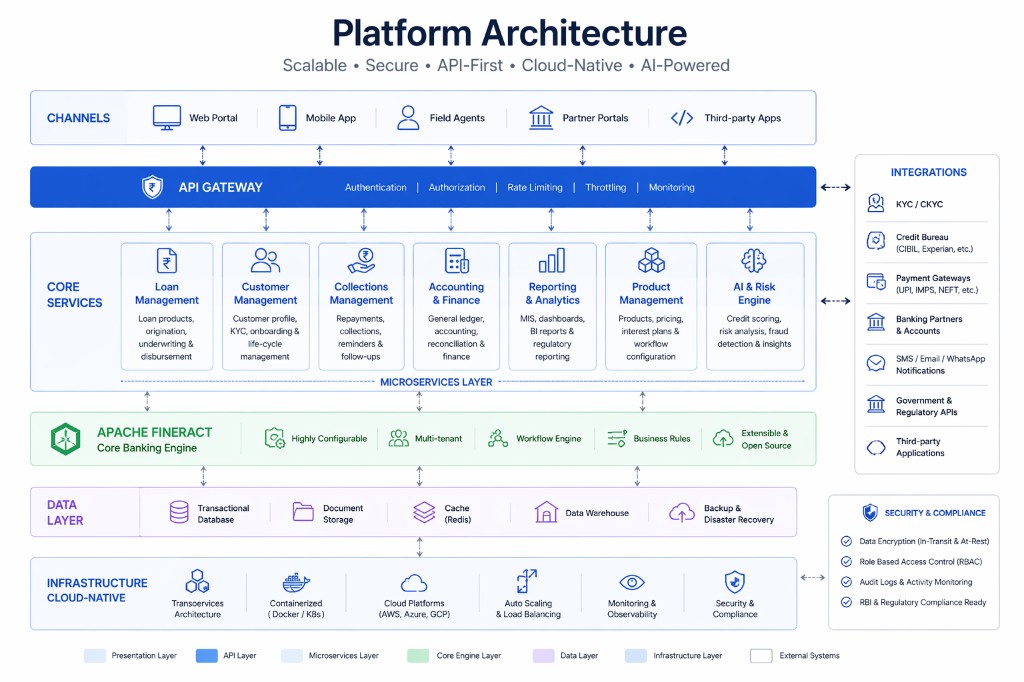
Typical Apache Fineract Microservices Architecture
A modern Apache Fineract deployment often includes multiple services working together.
Typical components include:
API Gateway
Acts as the single entry point for:
- Mobile Banking
- Internet Banking
- Third-Party Applications
- Partner Integrations
The gateway manages authentication, routing, and request validation.
Customer Service
Manages:
- Customer Registration
- Customer Profiles
- KYC Information
- Customer Groups
- Contact Information
Customer-related operations remain isolated from other services.
Loan Service
Responsible for:
- Loan Applications
- Loan Approval
- Loan Disbursement
- Repayment Processing
- Loan Closure
- Collections
This service can scale independently during periods of high lending activity.
Internal Link:
https://intelligrow.co/blog/mifos-loan-management/
Savings Service
Handles:
- Savings Accounts
- Fixed Deposits
- Recurring Deposits
- Withdrawals
- Interest Posting
Separating savings operations improves maintainability.
Internal Link:
https://intelligrow.co/blog/mifos-savings-module/
Accounting Service
Processes:
- Journal Entries
- General Ledger
- Financial Statements
- Accounting Rules
Accounting services remain independent while maintaining financial consistency.
Internal Link:
https://intelligrow.co/blog/mifos-accounting-module/
Notification Service
Responsible for customer communication.
Examples include:
- SMS Alerts
- Email Notifications
- Push Notifications
- Payment Confirmations
- EMI Reminders
Notification failures do not impact banking transactions.
Reporting Service
Generates:
- Portfolio Reports
- Financial Reports
- Branch Reports
- Regulatory Reports
- Executive Dashboards
Large reporting workloads can execute independently without affecting transaction processing.
Internal Link:
https://intelligrow.co/blog/mifos-reporting-guide/
Benefits of Apache Fineract Microservices
Organizations adopting microservices gain several advantages.
1. Independent Scalability
Each service scales independently.
For example:
- Loan Service can scale during peak lending seasons.
- Reporting Service can scale during month-end reporting.
- Notification Service can scale during bulk messaging campaigns.
This reduces infrastructure costs while improving system performance.
2. Faster Development
Development teams can work simultaneously on different services.
Examples:
- API Team
- Loan Team
- Mobile Team
- Reporting Team
Parallel development accelerates software delivery.
3. Better Fault Isolation
A failure in one service does not necessarily stop the entire platform.
For example:
If the Notification Service becomes unavailable:
- Loan Processing Continues
- Savings Transactions Continue
- Accounting Continues
This improves platform resilience.
4. Continuous Deployment
Microservices allow organizations to deploy updates without shutting down the entire banking platform.
Benefits include:
- Reduced Downtime
- Faster Releases
- Lower Deployment Risk
- Improved Business Agility
5. Cloud-Native Architecture
Apache Fineract microservices work well with cloud environments.
Benefits include:
- Auto Scaling
- Container Deployment
- Load Balancing
- Disaster Recovery
- High Availability
Cloud-native deployment supports long-term business growth.
Internal Link:
https://intelligrow.co/blog/mifos-cloud-deployment-guide/
Technology Stack
Organizations implementing Apache Fineract Microservices commonly use:
- Java
- Spring Boot
- Spring Cloud
- REST APIs
- Docker
- Kubernetes
- MySQL or MariaDB
- Redis
- RabbitMQ or Kafka
- NGINX
These technologies support highly scalable and resilient banking systems.
Common Challenges
Organizations adopting microservices may encounter:
- Service Communication Complexity
- Distributed Transactions
- Monitoring Multiple Services
- API Versioning
- Security Management
- Data Consistency
- Deployment Automation
- Operational Complexity
Proper architecture planning and DevOps practices help overcome these challenges.
Internal Link:
https://intelligrow.co/blog/common-mifos-implementation-challenges/
Deploying Apache Fineract Microservices with Docker and Kubernetes
Containerization has become the preferred deployment model for modern banking platforms because it simplifies application deployment, improves consistency across environments, and enables rapid scaling.
Apache Fineract microservices can be packaged into Docker containers and orchestrated using Kubernetes to build a highly available, cloud-native banking platform.
Benefits of Docker
Docker provides:
- Consistent Development and Production Environments
- Faster Deployment
- Simplified Dependency Management
- Easy Rollback
- Better Resource Utilization
- Faster Disaster Recovery
Each microservice can run inside its own isolated container, reducing conflicts between applications.
Kubernetes Orchestration
Kubernetes manages containerized applications automatically.
Its capabilities include:
- Auto Scaling
- Self-Healing
- Rolling Updates
- Service Discovery
- Load Balancing
- Automatic Restart
- Resource Scheduling
These capabilities help maintain high availability while reducing manual operational effort.
Organizations with multiple banking applications benefit significantly from Kubernetes-based deployments.
Microservices Security
A distributed architecture introduces additional security considerations because multiple services communicate continuously over the network.
Organizations should secure every service individually.
Recommended practices include:
Authentication
Use:
- OAuth 2.0
- JWT Tokens
- Identity Providers
- Single Sign-On (SSO)
Authorization
Implement:
- Role-Based Access Control (RBAC)
- Least Privilege Access
- Service-Level Permissions
Secure Communication
Encrypt communication using:
- HTTPS
- TLS Encryption
- Secure API Gateways
Secrets Management
Never store credentials in application code.
Instead use secure secret management solutions for:
- Database Passwords
- API Keys
- Certificates
- Encryption Keys
API Gateway Security
API Gateways should provide:
- Authentication
- Authorization
- Rate Limiting
- Request Validation
- Traffic Monitoring
- Logging
Gateway security prevents unauthorized access to internal services.
Internal Link:
https://intelligrow.co/blog/apache-fineract-security/
Performance Optimization
Microservices improve scalability, but they also require careful performance management.
Organizations should optimize:
Service Communication
Reduce unnecessary API calls.
Implement:
- Request Caching
- Asynchronous Messaging
- Efficient API Design
Database Performance
Optimize:
- SQL Queries
- Indexes
- Connection Pools
- Database Replication
Each microservice should minimize database contention.
Infrastructure
Monitor:
- CPU
- Memory
- Storage
- Network
- Containers
Infrastructure scaling should match business demand.
Load Balancing
Distribute requests across multiple service instances.
Benefits include:
- Better Availability
- Higher Throughput
- Lower Response Time
Monitoring
Monitor every service individually.
Important metrics include:
- API Response Time
- Service Health
- Error Rates
- CPU Usage
- Memory Usage
- Database Performance
Continuous monitoring enables proactive issue resolution.
Internal Link:
https://intelligrow.co/blog/apache-fineract-performance/
Best Practices for Apache Fineract Microservices
Organizations implementing microservices should follow proven architectural practices.
✔ Design Services Around Business Domains
Create services for:
- Customers
- Loans
- Savings
- Accounting
- Payments
- Reporting
- Notifications
Avoid creating overly large services that resemble monolithic applications.
✔ Keep Services Independent
Each service should:
- Be Independently Deployable
- Scale Independently
- Have Clear Responsibilities
- Minimize Dependencies
Loose coupling improves maintainability.
✔ Use Asynchronous Communication
For background processing, consider asynchronous messaging.
Examples include:
- Notification Delivery
- Report Generation
- Audit Logging
- Batch Processing
Asynchronous processing improves overall system responsiveness.
✔ Implement Centralized Logging
Collect logs from every microservice.
Log:
- API Requests
- Errors
- Authentication
- Business Events
- Infrastructure Alerts
Centralized logging simplifies troubleshooting.
✔ Automate Deployment
Use DevOps practices such as:
- CI/CD Pipelines
- Automated Testing
- Infrastructure as Code
- Container Registries
- Automated Rollbacks
Automation improves release quality while reducing deployment risk.
Why Choose Intelligrow for Apache Fineract Microservices?
Building a cloud-native banking platform requires expertise in enterprise architecture, distributed systems, DevOps, cloud infrastructure, APIs, and banking operations.
Intelligrow helps financial institutions design and implement scalable Apache Fineract microservices solutions.
Our services include:
- Microservices Architecture Design
- Apache Fineract Consulting
- API Development
- Docker & Kubernetes Deployment
- Cloud Infrastructure
- DevOps Automation
- Performance Optimization
- Security Hardening
- Integration Services
- Upgrade & Maintenance Support
Our specialists help Banks, NBFCs, MFIs, SACCOs, Credit Unions, Cooperatives, and FinTech companies modernize their core banking platforms using scalable microservices architecture.
Apache Fineract Microservices Checklist
| ActivityStatus | |
| Business Domains Identified | ☐ |
| Microservices Architecture Designed | ☐ |
| REST APIs Developed | ☐ |
| Docker Containers Created | ☐ |
| Kubernetes Deployment Configured | ☐ |
| API Gateway Implemented | ☐ |
| Security Controls Enabled | ☐ |
| Monitoring & Logging Configured | ☐ |
| Load Testing Completed | ☐ |
| High Availability Configured | ☐ |
| CI/CD Pipeline Implemented | ☐ |
| Disaster Recovery Planned | ☐ |
| Documentation Completed | ☐ |
| Production Go-Live Approved | ☐ |
Conclusion
Apache Fineract microservices provide financial institutions with a flexible, scalable, and cloud-native approach to modern core banking. By breaking banking functions into independent services, organizations can improve scalability, accelerate development, reduce deployment risks, and increase overall system resilience.
Combined with Docker, Kubernetes, REST APIs, centralized monitoring, and strong security practices, Apache Fineract enables Banks, NBFCs, MFIs, SACCOs, Credit Unions, Cooperatives, and FinTech companies to build high-performance digital banking platforms capable of supporting future growth and continuous innovation.
Partnering with an experienced implementation provider like Intelligrow helps organizations design, deploy, and optimize Apache Fineract microservices while ensuring long-term maintainability, operational efficiency, and regulatory compliance.
Useful Internal Links
What is Apache Fineract?
https://intelligrow.co/blog/what-is-apache-fineract/
Apache Fineract Architecture
https://intelligrow.co/blog/apache-fineract-architecture/
Apache Fineract APIs
https://intelligrow.co/blog/apache-fineract-apis/
Apache Fineract Performance
https://intelligrow.co/blog/apache-fineract-performance/
Apache Fineract Security
https://intelligrow.co/blog/apache-fineract-security/
Mifos Cloud Deployment Guide
https://intelligrow.co/blog/mifos-cloud-deployment-guide/
Mifos Implementation
FAQ
Frequently asked questions
Apache Fineract Microservices are independently deployable services that separate core banking functions such as customer management, loan processing, savings, accounting, reporting, and notifications. This architecture improves scalability, flexibility, and fault isolation.
Related topics
Apache Fineract
Apache Fineract vs Legacy Core Banking: Complete Modernization Comparison Guide
July 8, 2026
Apache Fineract
Mifos and Apache Fineract Explained: Understanding the Relationship Between Mifos and Apache Fineract
July 7, 2026
Apache Fineract
Apache Fineract Best Practices: Complete Guide for Successful Core Banking Implementation
July 7, 2026
Apache Fineract
Apache Fineract Upgrade Guide: Complete Guide to Upgrading Your Core Banking Platform
July 7, 2026
Apache Fineract
Apache Fineract Scaling: Complete Guide to Scaling Core Banking Systems
July 7, 2026
Apache Fineract
Apache Fineract Database Design: Complete Guide to Core Banking Database Architecture
July 7, 2026
Explore Intelligrow
Related pages you may find useful
Products
Reading apache-fineract-microservices — explore lending platform guides, product pages, and implementation resources across Intelligrow.